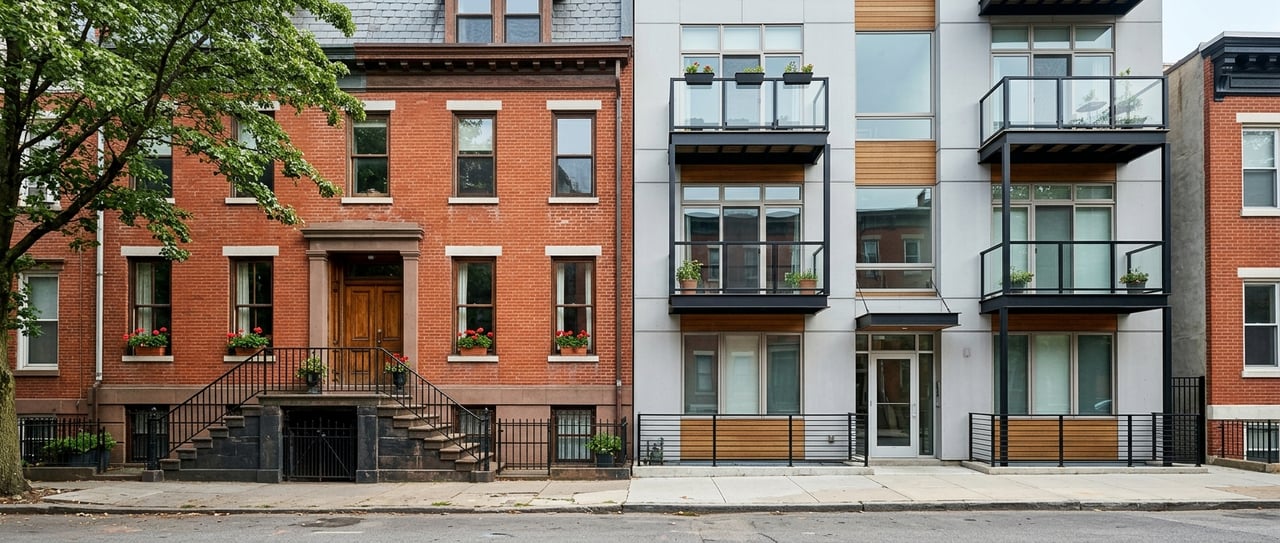
Wondering whether a DC rowhouse or condo makes more sense for your budget and lifestyle? You are not alone. In Washington, DC, the choice often comes down to how you want to live day to day, what monthly costs you can comfortably carry, and how much upkeep you want to handle yourself. This guide breaks down the key differences so you can compare your options with more confidence. Let’s dive in.
DC Housing Starts With Attached Living
Washington, DC has far more attached and multi-unit housing than detached homes. According to the DC Office of Planning, about 40% of homes are in large apartment buildings, about 27% are in smaller apartment buildings, about 23% are duplexes, and only 11% are detached single-family homes.
That matters when you start your search. In DC, condos and rowhouse-style homes are not niche choices. They are a big part of the market, especially if you want to live in established, close-in neighborhoods.
The housing mix also changes by area. Wards 1, 2, and 6 have more apartment-heavy housing, while rowhouses and smaller buildings are more common across much of Wards 4, 5, 7, and 8.
What A DC Rowhouse Really Offers
A DC rowhouse is typically an attached home that shares side walls with neighboring homes and creates a continuous street-facing block. Historic planning guidance describes rowhouses as one of Washington’s defining building types, known for brick facades, porches, rooflines, rear yards or alleys, and a consistent rhythm along the street.
For many buyers, the appeal is simple. You often get more square footage, more privacy than a typical condo, and more direct control over your property.
That control comes with responsibility. If you own a rowhouse, you are usually responsible for maintaining the full exterior shell and structural components tied to your home.
Rowhouse Maintenance Basics
When you buy a rowhouse, your maintenance list may include:
- Roof
- Masonry or brickwork
- Windows and doors
- Steps and porches
- Rear yard or alley-related upkeep
- Exterior repairs needed to keep the property safe and sound
This is one of the biggest differences between rowhouses and condos. With a rowhouse, you are typically making repair decisions yourself and budgeting for them directly.
If the home is in a historic district, exterior changes may also require preservation review. That can affect both project timing and cost, especially on older homes.
Rowhouse Pricing In DC
As of spring 2026, townhouse-style inventory in DC, which is a useful proxy for rowhouse-style attached homes, had a median list price of about $742,000. That is well above the current median condo list price.
In practical terms, rowhouses are often a better fit if you want more space and can support a higher purchase price plus a wider maintenance budget.
What A DC Condo Really Offers
A condo in DC usually means you own a unit inside a larger building, a smaller conversion, or a mixed-use development. Your ownership is generally limited to the interior of your unit, while shared building elements are managed through the condo association.
That structure can be attractive if you want a simpler ownership experience. You are often trading private outdoor space and full autonomy for shared maintenance and a lower average entry price.
DC insurance guidance makes the ownership line clearer. Condo owners are generally responsible for insuring the interior walls and floors of their unit, and they may also face association assessments for certain building-related damage.
Condo Costs Go Beyond The Sale Price
A condo can look more affordable at first glance, but it is important to compare the full monthly cost. In DC, condo and HOA fees are treated as property charges in homeowner-assistance materials, which is a good reminder that your housing payment is more than principal and interest.
When comparing condos, look at:
- Mortgage payment
- Property taxes
- Condo fees
- Homeowners insurance for the unit interior
- Possible special assessments
The District’s residential property tax rate is $0.85 per $100 of assessed value. On a $500,000 home, that works out to about $4,250 per year before insurance, condo dues, or maintenance.
Condo Pricing In DC
As of spring 2026, the median condo list price in DC was about $450,000. That lower entry point is a big reason condos are often the first stop for buyers trying to move from renting into ownership.
Current condo inventory is concentrated in places such as Capitol Hill, Logan Circle, Georgetown, Dupont Circle, Brookland, Northwest Washington, and Ballston-Virginia Square. In many cases, condo buyers are prioritizing location, convenience, and shared upkeep over extra space.
Rowhouse Vs Condo: The Core Tradeoffs
If you feel torn between the two, that is normal. Most buyers are balancing budget, space, monthly costs, and maintenance tolerance all at once.
Here is the simplest way to think about it:
| Option | Typical Strengths | Main Tradeoffs |
|---|---|---|
| Rowhouse | More space, more privacy, more control, possible outdoor area | Higher average price, broader repair responsibility, possible historic review |
| Condo | Lower average entry price, shared maintenance, often easier close-in living | Condo fees, less autonomy, less private outdoor space, possible assessments |
Neither option is automatically better. The better choice is the one that fits how you want to live and what you want your budget to do for you.
Which Option Fits First-Time Buyers?
For many first-time buyers, condos are the easier starting point because of the lower average price. When the median condo list price is around $450,000 and rowhouse-style inventory is closer to $742,000, that gap has a real effect on down payment, monthly payment, and cash reserves.
That said, a condo is not your only path. DC’s Home Purchase Assistance Program, or HPAP, can be used for single-family houses, condominiums, and cooperative units in the District.
Eligible first-time buyers may receive up to $202,000 in gap financing plus up to $4,000 in closing-cost assistance. That can widen your options significantly if you qualify.
A practical way to decide is to look at your monthly comfort level first. If condo fees plus mortgage still leave room in your budget and help you buy sooner, a condo may be the better launch point. If you have stronger cash flow and want space that can work longer term, a rowhouse may deserve a closer look.
Which Option Fits Move-Up Buyers?
Move-up buyers often lean toward rowhouses when the goal is more bedrooms, more storage, or outdoor space without leaving central DC. A rowhouse can offer a different kind of daily living than a condo, especially if you are ready for more independence in how you maintain and use the property.
Condos still make sense for move-up buyers in some cases. If you want a lower-maintenance home base, a more urban setting, or an easier transition from renting or a smaller unit, a condo can still be the right next step.
The biggest issue is usually not preference alone. It is whether your budget supports the purchase price gap and the longer-term ownership costs tied to each option.
What Buyers Moving From Virginia Should Know
If you are comparing DC with Arlington or Alexandria, the decision is often about lifestyle as much as commute. Arlington’s Rosslyn-Ballston Corridor is planned around dense, mixed-use, walkable transit villages, and Pentagon City is also a transit-oriented area within walking distance of Metro. Alexandria’s transit network includes Metroway, the West End Transitway, and multiple transit centers.
DC offers a different feel. In many neighborhoods, you are choosing a more historic, block-by-block city fabric with a stronger mix of rowhouses, older buildings, and dense neighborhood patterns.
For some buyers, that texture is exactly the draw. For others, a more transit-oriented suburban setting with newer buildings and easier parking may feel like the better fit.
How To Decide With More Confidence
If you are narrowing the choice between a rowhouse and a condo, start with a few practical questions:
- Do you want lower entry cost, or more space?
- Are you comfortable budgeting for exterior repairs yourself?
- Do condo fees fit your monthly budget comfortably?
- Would shared maintenance reduce stress, or feel too limiting?
- Are you open to older housing stock and possible historic review requirements?
- How long do you expect this home to work for your needs?
These questions can quickly reveal what matters most. The right answer is usually less about trends and more about your everyday priorities.
A smart search also means looking beyond list price. In DC especially, ownership costs can differ a lot depending on the property type, building structure, and maintenance profile.
If you want help comparing real-world options across DC and nearby Northern Virginia, working with a team that understands both markets can save you time and help you avoid apples-to-oranges comparisons. When you are ready to talk through your next move, connect with Meghan M Wasinger.
FAQs
What is the difference between a DC rowhouse and a DC condo?
- A DC rowhouse is typically an attached home where you own and maintain the full property, while a DC condo usually means you own the interior of a unit and share building responsibilities through a condo association.
Are DC condos cheaper than DC rowhouses?
- On average, yes. As of spring 2026, current DC condo listings had a median price of about $450,000, while townhouse-style listings, a useful proxy for rowhouses, were about $742,000.
What maintenance costs should buyers expect with a DC rowhouse?
- Buyers should plan for roof, masonry, windows, doors, steps, porches, and other exterior or structural upkeep, plus possible added review time for exterior work in historic districts.
What costs should buyers compare when shopping for a DC condo?
- Buyers should compare mortgage payment, property taxes, condo fees, interior insurance needs, and the possibility of special assessments, not just the purchase price.
Can first-time buyers use DC assistance programs for condos and rowhouses?
- Yes. DC’s HPAP can be used for eligible purchases of single-family houses, condominiums, and cooperative units in the District.
Is a DC rowhouse or condo better for buyers moving from Virginia?
- It depends on your lifestyle goals. DC often offers a more historic, block-by-block urban feel, while Arlington and Alexandria may appeal more if you prefer transit-oriented settings with a different housing mix and, in some areas, easier parking.